Sunday, January 13, 2013

47 - Cry my beloved country

It is with much dismay and disappointment that we look at our neighbour in the region, Pakistan. Right from its inception - indeed even from before inception - Pakistan has caused pain and anguish to us. As if the horrors of partition were not enough, it forced number of wars on an India aiming to achieve larger goals in its young life. Wars that with or without support of its American Patton tanks and Chinese logistics and arms support, Pakistan lost thoroughly each time.

There were number of gracious gestures from India through the years - in the spirit of an elder forgiving the wayward and trauntbchild in the house. Even though it pains us when Pakistan sponsors Terrorists in India, even though we are hurt with the violence, the anguish that Pakistan causes, even in fact if we are depressed at the ways in which a sadist Pakistan is destroying itself through Talibanization and by butchering their own people - whether Sias or minorities.

Even with all this, we have only wished well for a successful and progressive Pakistan. If for nothing else, just because happiness and progress in Pakistan will mean peace and prosperity in all of Asia and Indian sub continent.

And yet, when an incident like this happens, when Pakistan army is gruesome enough to physically behead an Indian soldier captured or killed by them, when a Pakistani soldier carries off the head of an Indian counterpart - like some cannibal or carnivorous animal, we are sick to the pit of our stomach.

What are we dealing with here? Are these human beings or some zombies devoid of any human emotion or feeling? Is this a Pak-istan or some land of the Devil or Shaitan that we are dealing with? Are these really Muslims, devotees of Allah or are these Pakistanis Devil worshippers, followers of Satan himself?

Our anguish is tremendously multiplied because we still think of this land - and people - as a separated part of our country, a temporarily disconnected part of our Akhand Bharat. But how can we be at peace when this part of Akhand Bharat has been so severely affected by the cancer called Pakistan? We can but pray to the One God for a cure from this cancer.

Wednesday, June 27, 2012

46 - It Wont Really Happen To Me or Why BCM is like Selling Life Insurance

Many years back, I used to sell Life Insurance. It was a brief period in my life and was possibly the one job where I made the worst financial returns in my career – but also one which was an exceptionally satisfying job I ever had. Surprisingly the reason for both was the same – I insisted on selling only two type of Insurance Plans: one a pure Life Insurance plan (if one dies, his family gets a significant Insurance pay-out) and another a Pension Plan (which covers the risk of living too long- but that’s another story for another post). Neither of the plan types make any decent commission for any Insurance Agent!

The first plan is very different from other more popular (but expensive) Insurance plans (which are actually long term Savings schemes) which have a very low Sum Assured but pay out a decent Maturity Value after 20 / 25 / 30 years. The pure Life Insurance Plan covers risk only, has a very low premium and is the safety net that can protect one’s family in the scenario of an unfortunate event. Logically, it is the one plan that a family man needs to buy if he never does any other saving or investment ever again in his life. Obviously one would think it must be selling like hot cakes; any Insurance Agent will tell you this is the one most difficult plan to sell!
Don’t get me wrong, no one doubts how necessary Life Insurance is and how important it is for the bread-winner in a family to get himself (or herself) insured. And yet, people put it off for the most mundane of reasons – “maybe next year”, “I have enough Insurance” (when they are actually referring to a Savings plan), or the worst “If I live through those 25 years, then I won’t get anything”! The real truth is while everyone knows how important it is and would advise their best friend to go for it, very few people buy a pure Life Insurance plan for themselves (unless hounded by a angel Agent like me) for one simple reason: no one believes that anything bad, leave alone some fatal thing like death, can happen to them. I mean we all know it is inevitable but we all believe that somehow we are going to escape it.
Okay, let us get to something less morbid now. Information Technology. Something similar in the field of IT is IT Services Continuity (call it IT Disaster Recovery or Business Continuity Management or Business Continuity “Plan” whatever makes you comfortable).

 It doesn’t matter what name we call it by. A good many, if not all, of us sincerely believe that it is a necessity. From Strategic perspective to Operational. From Best Practices perspective to Risk Management. Whether it is the Business or the IT Departments, it is no one’s argument that BCM is not required. And then when it comes to the crunch, how many times we have heard all those excuses for putting it on hold, doing it some other time, waiting for some other day, waiting for when we have some time and money to invest … Isn’t it the same syndrome – it won’t really happen to me?

Saturday, June 23, 2012

45 - COBIT 5 Response to Stakeholder Needs

Very recently, ISACA has come up with a new version of its flagship product Control Objectives for Information and related Technology i.e. COBIT 5. Undoubtedly there will be a lot of debate whether COBIT 5 will be as popular or more than the previous versions of COBIT.

As is well known, COBIT has gone through some “Avatars”. What started in 1995-96 was the Auditor’s version of Control Objectives. In subsequent versions it went through flavors of Control-focus, IT Management focus and then IT Governance focus in the previous version i.e. COBIT 4. As an IT Governance and Control framework, COBIT 4 scaled ever higher than previous versions and is recognized as a de-facto Standard for Enterprise IT Governance. Obviously there are number of comparisons and discussion vis-à-vis the ISO Standard for IT Governance viz. ISO 38500. COBIT 4 encompassed all the required principles to assume its position as an IT Governance Frameworks.
IT Governance Focus Areas
Rightly COBIT 4 set out the focus areas viz. Strategic Alignment, Value Delivery, Risk Management, Resource Management and Performance Management. Always implicit (and many times explicit) was the direction to start with the Business Goals, cascade down to IT Goals and then accordingly go about selecting Control Objectives and Processes relevant to the organization. Thus the focus on “Stakeholder Needs” (which is now the First Principle of COBIT 5) was always there, though implicit.

Unfortunately the knowledgebase of COBIT 4 (and earlier versions) set out the Control Domains and Objectives so well in terms of “Plan and Organize”, “Acquire and Implement”, “Deliver and Support” and “Monitor and Evaluate” that it was always a very tempting option for IT Departments to pick up the guidance and get “down to implementation”. Leave alone being Business driven or starting from Business goals, Business teams are not even aware of any framework called COBIT being taken up for implementation.

For instance we were proudly presented the IT Policies and Procedures by an IT Manager saying these were “A&B Policies” (where A&B stands for the name of a leading Big 4 Audit Firm). These “A&B Policies” were being used as the IT Policy and Procedures or Manual document by the IT Department. We were dismayed to see the documents were a verbatim reproduction of COBIT 4 content down to the “PO1”, “PO2” … “AI3”, “AI4” and so on …

In another IT Department an IT Governance Manager (yes there is actually that title in use) showed us the numerous documents, policy and records she had built up over more the 3 4 years. To be fair, a tremendous amount of effort and meticulous documentation had gone into the artifacts. When we asked her about which Business or IT Goals were selected to start with, she casually told us that the Business teams had not really go around to sharing any goals with the IT.

So, in all, though COBIT 4 was positioned as an IT Governance framework, my guess is it is still received or used as a more glamorous IT Management guidance. In that, COBIT 5 is surely beating a new path but also entering an un-chartered territory. Unequivocally it has set across that IT Governance needs to start with Stakeholder needs. This promises to take the COBIT framework and future IT Governance implementations to an all new level.

Yet, this by itself may also be a big challenge or risk that COBIT framework itself may face in the days to come. IT Departments which were comfortable adopting COBIT as an IT Management framework may think twice before taking such a potent tool to the Business Departments. Come to think of it, IT Governance is an excellent tool for the Business Stakeholders to evaluate the value delivery from investments into IT. But how many IT departments are truly confident of standing up to such scrutiny? There lies the real problem behind adoption of IT Governance.

We always expect IT Departments to adopt and drive COBIT implementations in the organization. For obvious reasons there is a natural conflict of interest there – why would IT Departments make things more difficult for themselves? Besides it is always easy to say that Business Departments have no real understanding of Technology and going to them for “Approvals” or so on would only delay everything increasing inefficiencies. For instance, anyone who has gone through a Business Impact Analysis for a Business Continuity Management project is well aware of such arguments.

So what then is the way forward? Internal Audit Departments or independent IT Risk Management teams are still the most likely candidates to drive IT Governance adoption and succeed in implementing IT Governance in organizations. COBIT 5 has stepped forward and taken some risks in moving the focus to Stakeholder Needs. Business Departments need to mover forward and embrace COBIT too. Boards, CxOs, Business Leaders across the spectrum have to shed their inherent anxiety of COBIT as an “IT framework” and work with it to really strengthen Enterprise Governance in the organization. After all, the key concept is that IT Governance is an integral part of Enterprise Governance. One, without the other, is just not there …

Tuesday, August 16, 2011

44 - Random Thoughts

Corruption - worldwide - is but a symptom of the deeply rooted spiritual bankruptcy in society. Society and individuals lack the moral strength to withstand onslaught of material desires. As Gandhi is supposed to have said "There is enough for everyone's need; there is not enough for one man's greed".
Social and political protests may only replace one ruling order by another. But they cannot treat this deep-rooted sickness in society - because a sick man cannot treat himself and in any case, treating symptoms will not lead to the ultimate cure.
Till human beings can find the way - and it is very much possible - to go beyond material desires, symptoms such as corruption, crime, terrorism, riots will continue to trouble society and us.

Monday, April 5, 2010

43 - Two wheelers and Motorists in Pune

Dear All,
Just am back from a personal visit to Pune.
It is a nice city but quickly losing its older charm. The emerging industries, IT companies and others in and around Pune has attracted large scale emigration from all parts of the country and has increased crowds, congestion and pollution. In few more years it is going to become a dying city like Mumbai. But as usual, this is all off-topic. The topic really is about the age-old characteristic even tradition of Pune - i.e. two wheelers.
Older Pune was abundant with bicycles - pedestrians used to be in mortal fear of being knocked down even on the foot-paths. As children we were always warned with one mantra - watch out for the cycles! Today cycles have given way to bikes, scooters and scootys ... even 14 year old kids are whizzing past on easy to start and automatic gear two wheelers. Large number of two wheelers are competing with increasing number of three wheelers and cars of all shapes and sizes.
And the pedestrian fears have increased manifold !
Personally I was witness to a small accident. One senior member of our family was knocked down by a scooty speeding down as he crossed a narrow (8 feet wide) road. Luckily he escaped with a few minor bruises and a sore shoulder. The driver was a teenage girl who herself was scared out of her wits by the accident. What struck me was her immediate apology and comment after the incident "It was neither his fault nor it was mine ... he crossed the road and I thought he had seen me and would stop"!

While this comment may seem idiotic, this is characteristic of the driver ethic in Pune. Drivers assume that pedestrians should be cautious and stay out of way of vehicles. Frankly, I do not believe this is acceptable. It should be remembered that pedestrians do not have to apply for a license but drivers do. The intention of this is that driving a vehicle is not a right, but a privilege. With that privilege also comes a responsibility to protect the safety of self and those around. If a driver fails in this responsibility and is part of an accident, he or she definitely is responsible for this. I think two wheeler drivers in Pune (and even other cities including Mumbai) need some lessons in road safety and civil behaviour. But then, this is known since the last century.
God Save Pune.
Best Regards
Gotya

Monday, March 29, 2010

42. More on Seven Habits

Dear All,

Thank you for coming back today.

In my last post I was ruminating about a few books I read and I mentioned Stephen Covey's book "Seven Habits of Highly Effective People". I first read it when I was a school kid and found it to be a really well written and entertaining book. Really liked it but like the proverbial cock and the diamond, at that point since I could not eat (digest) it, the habits really did not 'click' with me. I hardly realized what a prized possession it was and consequently it stayed in a dusty corner of my house for number of years. Incidentally due to various reasons I also cultivated two bad habits that have been my bane till date – laziness and procrastination. There was a period of time when I used to be actually happy when someone called me lazy – but now, I really digress.

Fortunately for me in recent years I came into contact with several people (including my better half) who are tremendously hard-working. Interacting with these people I could realize the value and premium that is placed (in the work place at least) on developing qualities like perseverance, timeliness, consistency … Obviously there was an urgent need for introspection and change.

Books are good friends to have around you. They give you advice (some times good, sometimes bad) and they give it to you when you want it. If you don't feel like hearing the advice, they don't nag you. And if you don't like or take the advice they don't take it personally – they will still advice you with the same patience the next time you turn to them. So in my present predicament I turned to many books. And finally came around in a full circle to The Seven Habits

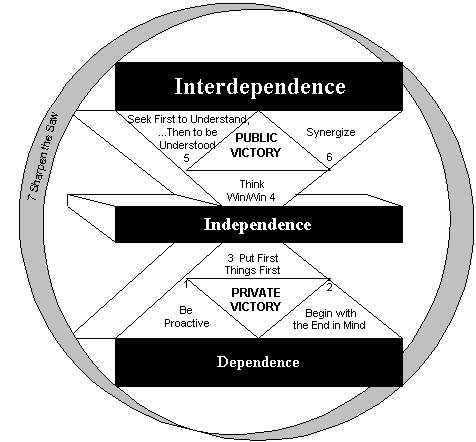
Simply put, the book puts the context of three levels ("Dependence" – "Independence" – "Inter-dependence'). An excellent diagram is available here and this link has a very good and comprehensive summary of the message – so I will not reinvent the wheel. The essence of the book is its focus on the "character-ethic" which postulates that success is attributed to underlying characteristics (integrity, hard work, patience, …) and not merely personality traits (which may be cosmetic). The take-home for me was that "victory over self is essential before any other (public or private) victory". Indeed victory over self is by itself a worthwhile desire and goal even if nothing else is ahead of it.

So the re-reading this time was good - better than the first attempt. Yet, the thought at the back of the mind was (rather, is) that unless one has really understood, assimilated and inculcated the first three habits, there is no real need to just read beyond. This is nothing short of cleaning the Augean stables. Each of the first three habits ("Being proactive", "Defining your goals and directions", "Managing your timeliness") are giant leaps by themselves. And to reach anywhere near developing these habits will take years if not lifetimes.

I have only just started on the journey and can only hope that it is led to its logical conclusion. Perhaps in time my basic nature will take over (although I pray with all my heart against it) and lead me somewhere else again. Perhaps in future posts, I may be able to report on any progress (or symptoms of progress). Anyways introspecting on Habit 2 (Decide on your end goals) brought out some really interesting thoughts.

Without really explaining those thoughts let me just recall one story I had read about Swami Vivekananda and his Guru Sri Ramkrishna Pamahansa. Apparently Swami Vivekananda (then Narendranatha Dutta) was faced with severe financial difficulties and went to his Guru for guidance. His Guru asked him to go to the Mother's temple and ask for money, success, job, whatever he wanted. He promised that the Mother is very kind hearted and will agree to give whatever Narendra asks for. Apparently Narendra went thrice to the temple and returned. Each time he confessed to the Guru that he was not able to ask for money, job or any material desire. When asked why he replied that if the Mother is large hearted enough to give anything, how can we ask for something so trivial as money and job?

Forgive me readers, if I have got any details in that story wrong. The point is to leave you with some food for thought and hope that you come back later for some more. Have a good day …

Cheers

Gotya

Monday, March 15, 2010

41. Some readings and some musings

Dear All,

I wrote earlier about reading some interesting books across last year. Some thoughts collected from those readings ...

Perhaps, it all started when I got an article about "10X Change" and strategic inflection points. Led me to the first book "Only the Paranoid Survive" by Andy Grove of Intel. An excellent book about strategy, being aware of change potential and being prepared to deal with sudden change - even leverage it to get ahead of the competition. Was fun reading it. Absolutely recommended. Particularly in these times. But as I read it I was also reminded of another book read long ago - "Who Moved my Cheese". Lot of parallels in the stories although the later is about a few hard-working mice and managing changes in personal and work areas. But you get the idea.

Incidentally discussing about these two books with my good friend Atyab pointed me to another book, this time about operationalizing strategy - making sure we end up doing what we are planning. Not just dream about it. This was a high calorie food for thought "Execution- The Discipline of Getting Things Done" (Larry Bossidy and Ram Charan). But to be honest I did not read this completely. I could not. The book is really targeted at very senior management professionals. So it was like drinking directly from the Ganges - I was happy to fill in a small glass and sip from it. :-) The book is about lot of things - setting goals, establishing appropriate processes, selecting the right people to run these processes, leading them in the right way. Way to go for great CEOs I guess. But it underscored one very important thing for me.

Unless one is having the discipline to control oneself, there is not much point in thinking about leadership and strategies and execution. How can one 'select', 'review', 'lead' other people unless one knows, reviews and repairs one's own faults first? One does not need to lead millions of people like a Gandhi or a Martin Luther King (or a Mel Gibson in Braveheart) - it is very much sufficient (and necessary of course) to lead oneself to the light first. The one-eyed man leading the blind is only for the tales.

So some introspection brought me back to a book I had picked up when in school and read but not yet implemented. Perhaps not even understood completely yet. "Seven Habits ..." by Stephen Covey. An amazingly simple, yet truly inspiring book. I read it again - this time seeking for guidance. Again I could get no further than first three or four chapters. Let me explain why ... but in the next post ...

It will give me some breather and just so you guys will wait here for me ;-)

Cheers

Gotya

Sunday, March 14, 2010

40. some reading and some introspection

Dear All

Haven't posted much in the last few months - perhaps only 2 or 3 posts in all of last year. Updated my Teletechgyan after a gap of 2 years. But all that (or most of it at least) was not due to laziness.


Part of it was of course, due to my introduction to Twitter. Twitter is the lazy man's blog - microblog to be precise. To a large extent devoid of any purpose - even aimless if I may say so - Tweeting still has its fun and is duly addictive. I believe it reflects the restless nature of the human mind. Just as it is possible for the mind to jump from one thought to another - one moment to the next - so also Twitter allows the users to tweet totally unrelated and yet connected stream of messages one after another. Just as thoughts may be entirely random and yet connected, Twitter's public timeline can be full of random thoughts, news, perspectives from all across the world - some entirely worthless while others totally invaluable. The only flaw is that it also sort of trains your mind to not collect all these thoughts and put them together. One would rather dump out those thoughts like a kid shouting at the mountains to hear his own echo than take the efforts to hear his own voice and refine it in the hope of contributing something worthwhile to posterity.


And yet, that is not the topic of today's post. While Twitter seems to be one of the reasons for not taking the efforts to blog, that was not the only reason. One of the other things were a lot of self-doubts or at least questions about the usefulness of it all. Why think aloud - for that is what this is really about - in the (almost conceited) belief that these thoughts really mean something to anyone at all? Yes there are some loyal readers who visit this blog, email me about it and also take the efforts to comment. But to be honest the visitors are my friends who visit and comment because of their love for me more than perhaps any value that I am adding to them. Of course that is a good a reason (in fact better than) as any other reason. Just to thank and appreciate that love and friendship I should take the efforts to blog. (And I will). And yet, the thoughts are still about what is the value that I can create for them? That question, alas, is still not answered.


I know this is becoming some form of a theatrical monologue but honestly, that is not where I started off with the introspection bit. Anyways since the question is now about what value I can contribute and since I honestly cannot think of something original to speak (and can't get the wisdom to be silent either), perhaps I can borrow from some interesting reading I have been up to in the last few months. But that will surely have to wait for another post, another day. Keep watching this space.

Cheers
Gotya

Monday, May 25, 2009

Have we forgotten Burma and Tibet?

In the last few days we have been reading news about Nobel Prize winner Daw Aung San Suu Kyi's strange misfortunes in Burma (Myanmar). The heroic lady has been in prison for years now - two decades in fact since 1989 - and just as the term seems over, some mystery swimmer puts her back on Square One. What has been happening in Burma and why is the world ignoring it for most part? Is it really an internal issue of the country when someone who is elected to be the Prime Minister is placed out of touch with the world for such a long time? Why are countries like China supporting Burma?

Perhaps that last question is dumb. Why wouldn't China be backing Burma when it has a Tibet in its own backyard. A place that China is making all out efforts to wipe out from the world's memory. The Dalai Lama - another Nobel Peace Prize winner - is one of the best recognized faces in the world and none who recognized that face is unaware that he is in exile from Tibet all these years. Yet, China can pressurise - even threaten - the world into ignoring him and steering away from any official contact with Tibet.

Apparently now, European (British) and Canadian firms are mining in Tibet - obviously with the approval of China. Perhaps these companies are environment-friendly and will ensure that Tibet's natural environment is not spoilt by the mining activity. Perhaps these companies being socially responsible are taking steps to ensure that Tibetian people will derive the benefits of such activity. Yet, we are not sure. People have put up protest pages urging these companies to stop mining in Tibet. Who is right and wrong on these issues? There is surely no way to know unless China loosens its stranglehold on the information flowing out of Tibet. Which is not going to happen anytime soon.

Has the world - have we - forgotten Tibet and Burma? Or are we just acknowledging that if the perpetrators are really powerful it is better to steer clear? Or is it that because these victims are adopting peaceful methods that they are easy to forget? Too many questions - perhaps dumb questions - and no easy answers.

Best Regards
Gautam

Monday, December 1, 2008

Nutty predictions

Hi All
"I think there is a world market for maybe five computers". That was an IBM prediction in 1943 - which is today counted among the 10 worst predictions ever. Now IBM is at it again - predicting that is and I guess it has bettered its crystal ball since 1943 ...
CIO India reports some of the IBM predictions in its third annual Five by Five list. One of the predictions that got my attention was:
"You will talk to the Web . . . and the Web will talk back." Someday soon you will surf the Internet using just your voice, a development that will make the Web more widely accessible worldwide, particularly for those who cannot read or write.
Interesting not that IBM believes the Web will talk but that it also believes that five years from now, there will still be people - particularly in India - who will not be able to read or write.
Now, I wish this is one prediction we as Indians could prove wrong.
Best Regards
Gotya

Tuesday, September 30, 2008

Creator of the Kohinoor?

Hi All
I had a fun time last two weeks as I joined a conducted tour of Europe. Travelled through 7 countries in the last 14 days. One of the tourist attractions was the Coster Diamond Factory in Amsterdam.
Its a nice place with lot of informative and sales stuff on diamonds and related jewellery. They seem to be good at their work and one of their claims-to-fame is that many years back Moses Elias Coster was invited by the Queen of England to polish/ re-cut the Kohinoor Diamond - expectedly to add to its fire and beauty. What surprised me is that this seems to be enough for this factory to claim to be "Creators of the Kohinoor" ... you can clearly see this label in the picture alongside which was taken in their factory. They have displayed a replica of the Kohinoor in their shop which is photographed. Zoom in and read the first line below.

Ofcourse here (as in most other western museums which display stolen artifacts) there is no mention that the Kohinoor is part of the looted bounty from Indian heritage. But I will let that point rest as much has been said about this already ...
I found at-least one other reference which went on to say that while the re-cuting work done by Coster on the Kohinoor did not add much to the stone's brilliance, it certainly diminished from its historic value. So I wonder whether Coster would accept this graciously and re-phrase that "Creator" to "Destroyer" or at-least "Damager" ...
Best Regards

Tuesday, September 2, 2008

36. Notes on Information Systems Architecture

Hi All,
I have been learning a little bit about Information System Architectures and the start point just has to be the Zachman Framework. Perhaps the Zachman Framework is to Architectures what the Deming Quality Cycle appears to be all Management consulting. Of course some of my friends call it the “Hamster Wheel of Pain” but that’s another story …

An interesting extract from the article (that I reproduce here – more as a “note-to-self”) follows. He ( Dr. John Zachman - Biographical Sketch) first discusses the various perspectives or fundamental architectural representations such as Owner’s view, Designer’s view, Builder’s view etc. and then goes on to say:
A significant observation regarding these architectural representations is that each has a different nature from the others. They are not merely a set of representations, each of which displays a level of detail greater than the previous one. Level of detail is an independent variable varying within any one architectural representation…

The original article appeared in IBM System Journal Vol. 26, No.3 of 1987 and is a must-read.

Best Regards

Tuesday, August 12, 2008

35. Web Version 2

So, what does Web 2.0 mean to you?
Some of us know it only as a jargon that seems to be catching up to Internet users. Some of us may think it as yet another "IT" thing floating around. Some honest ones will admit to not having heard much.
But rejoice ... if you are reading this you are already part of Web 2.0 :-) So also when you login to Orkut or LinkedIN, search for that elusive bit of detail in Wikipedia or use the smart mobile application which shows the apartments for sale in your favourite city on Google Maps - complete with the driving directions to it. (Okay that last "Mashup" is yet to be created or atleast popularised). Or you might just want to twitter about what you have been up to recently ...
I will not go much into what Web 2.0 is or how to define it and stuff. Tim O'Reilly has already done a fantastic job of it years ago. But two main streams of thoughts come to mind:
  • What sound business ideas exist to make money out of this? Or atleast to avoid the repeat of the dot com bubble burst? Interestingly I was reading a McKinsey Global Survey (June 2008) result on "Building the Web 2.0 Enterprise" and a key point made by the report is that "Satisfied respondents say that, in large measures, business units rather than IT departments are driving the selection of Web 2.0 Technologies" - where IT units take the lead, it is leading to more number of dis-satisfied users or even rejections of the technologies. (So its not an IT-thing after all).
  • What new risks will present themselves to Internet users or IT users from Web 2.0 usage? Ofcourse the most obvious answer is related to compromise of personal information, privacy, "identity theft" etc. but whether Web 2.0 can be blamed for these risks is food for thought. Admittedly Web 2.0 makes it easier - perhaps even enticing - for people to offer their personal information for public consumption, but what does it say for the awareness level or discretion of users in the first place? We are sure to see some thoughts on this in coming days.

More than ever, the all-important question is "what do you think about it" ?

Have a good time

Best regards

Gotya

Thursday, July 17, 2008

34. Wonderful Leela of Shri Sai

Few months back, I was reading one of the chapters in Shri Sai Satcharitra - the wonderful life and teachings of Shri Sai Baba of Shirdi. At one point, there is a story of how a devotee starts reading the Guru Charitra - which describes the wonderful incarnations of Shri Dattatreya and the beautiful relationships between Guru and Disciples.
A desire awakened that I should also read the Gurucharitra and benefit from the nectar of the sweet words therein. At the same time a small thought came into my mind that I should read it only when some instruction comes from Shri Sai. I thought that if someone were to give me a copy of this holy book - without my asking for it - I will surely start reading it. At the same time, I also thought that it is a bad sign of ego on my part that I want my Sadguru Shri Sai to come and make it available to me - as a pre-condition to reading it. I silently prayed that it should not be considered so and somehow Baba should acknowledge my desire and strengthen my faith.
I half-expected that when I visit my home in Mumbai my mother - who usually reads and keeps such holy books - would give me a copy of the Gurucharitra, which would be my signal to start reading it. I also worried that my mother would give me a Marathi copy and I would have to read it. (Although my mother tongue is Marathi, my near and dear ones know how much I find difficult even to read some simple text in Marathi - so I was worried how I would read it). As it turned out, my mother did not give me any such book and as per my desire I did not want to ask for it. So I was sorely disappointed.
But Shri Sai Baba is all knowing and his ways are also such that he gives his devotees exactly what they need and in his own ways.
A few days back as Ashada month started, He first ensures that I had a Vitthal Darshan and a view of the Warkaris heading towards Pandharpur. Then He awakened a desire to search online for some pictures of Shri Sai Baba. In this quest, I also discovered the online version of Shri Sai Satcharitra which I posted in my previous blog post.
In the above mentioned search I also came across the online copy of the GuruCharitra in English. Exactly as I wanted ! Further the timing of this was just perfect. I came across this on the day of Ashada Ekadashi - a few days before Guru-Pournima. I was so thrilled by this occurrence that last few days I was just reading it and only managed to finish the first reading today - on Guru Pournima.

I know it sounds such a coincidence and luck maybe. But I believe there was some divine coincidence and Shri Sai Baba has not only understood the small desire that arose in my heart - He has also ensured that the reading is completed in the days before Guru Pournima.

I was just so thrilled with this set of events that I had to blog about it and hope that this experience also provides some joy to other Sai Bhaktas who chance upon this post.
!!! Shri Satchitananda Sadguru Sainath Maharaj Ki Jai !!!

Saturday, July 12, 2008

33. Link to Online SaiCharitra

Since I posted last year about Guru Pournima, I noticed a stream of visitors on this blog who were referred through searching Google for the words "Guru Pournima" or were searching the web for images of Sadguru, Shri Sai Baba. Knowingly or unknowingly if this blog entry has been of use to Sai-bhaktas around the world, I can only consider it my good fortune.


Following are some more links which may be of use to Sai-bhaktas who come up to my blog:

  • The Shirdi Saibaba Sansthan Trust in Shirdi which is doing a very good job of facilitating devotees to reach their everything - Sadguru Shri Saibaba.
  • The Sai Satcharitra - the English version of the holy book for all Sai devotees. This is not just a book but it is the lifeline holding which we shall float across the sea of all joys and sorrows, all excitements and disappointments and finally be reunited with the One.
  • Apparently also there is a Shirdi Sai Temple in New York in the one and only US of A. This site has taken a lot of efforts and pains to set up the Sai Sat Charitra on the online version. Besides they have a nice download center and other useful resources for Sai Bhaktas.

I have tried to include here some resources which may be of use to the Sai Bhaktas who have been visiting this blog. If there is anything specific I can add, please feel free to request through a comment here and with the will of Shri Sai, I will try to do so to the best of my ability.

Best Regards

Gautam

Sunday, June 29, 2008

32. Tungaska Event

Hi All
Did you know that an explosion about 1000 times as strong as the Hiroshima bomb rocked the earth just 100 years ago - on June 30 1908 - years before the World Wars? And the culprit was not any superpower country but good old Mother Nature?
The Tungaska event is described as the strongest significant meteorite airburst (the comet / meteorite / whatever it was ... just about kissed the earth that day) exploded with an energy equivalent of 10 to 15 Megaton of TNT (believe me, you dont want to be anywhere near when that happens). The saving grace was that it occured over a remote part of Siberia with minimal population in those days. It is said that if the explosion occured just 4 minutes later, it would have occured over St. Petersburg - completely destroying the Russian capital. Even in those days, the signs of the explosion were picked up as far as Great Britain.
Read more here ...

Have a safe time ...
Best Regards

31. Oil and Gas Industry Information Links

Hi All

Came across a very good question on LinkedIN today related to study resources for beginners to the Oil and Gas industry. Thanks to Mr. Jesse Pickard who initated this question and to 15 people who have given some excellent resources for study.

I am bookmarking this question - hope you are too ...

Best Regards
Gautam


Tuesday, June 17, 2008

In memory of the immortal Queen

Hi All
I havent posted anything here since the start of this year and my apologies to all of you for the delay. Today is the 150th anniversary of the martyrdom of one of the greatest patriots - Rani Laxmibai of Jhansi. Which Indian has not been moved as a child by the story of this Queen riding to her death with her child tied behind her back?

There are some moments, words, events which never fail to touch the innermost chords of one's heart. Try listening to Lata Mangeshkar as she sings "Ae mere watan ke logo ..." or a rendition of "Vande Mataram" from the film Anand Math (hope I am right about the name of the film - its been a very long time since I saw it) and write to me if they dont move you to tears ... (the challenge doesnt hold if you are not Indian or dont know Hindi ofcourse). If there is a poem that has the same effect, it has to be Subhadra Kumari Chauhan's "Khoob Ladhi Mardani" ... Which school-child's imagination has not been stirred by those lines - which Indian girl has not wanted to stand on stage with the sword raised and proclaim "Main apni Jhansi nahi doongi !" (" I will not give my Jhansi").

Well before I get all mushy about this, here are a few links you might like:

Those of you who are in Pune today (17 June 2008) may want to attend this program (at 6 pm at the Abasaheb Garware College auditorium) organised by the Maharashtra Education Society (MES), in collaboration with the Swantantryasamarache Shatakottar Suvarna Mahotsav Samiti, an association formed to celebrate the golden jubilee of 1857 freedom fighters.

Best wishes all and have a good time, till we meet again ...

Best regards

Gautam

Thursday, December 27, 2007

Entrepreneurship

Hi All
Today I read a small query on LinkedIN by one Mr. Alexander Zachary "Why aspire to be an Entrepreneur?"

Peter Nguyen has provided a beautiful response here ... As I have linked to earlier I am a fan of Peter's blogs such as Real Time Success Secrets and I-wrote-the-book-on-blogging and read and re-read them as and when possible.

Thanks to both Alexander and Peter for such a wonderful converstion on LinkedIN.

Best wishes to all of you.
And Happy New Year for the forthcoming. Have a great time. Party hard and have fun

And if you drink ... dont drive !!! Please !!!

Cheers
Gautam

Tuesday, November 27, 2007

Landmines in Africa


Hi All
Today on LinkedIn one particular message drew my attention. Apparently it was some online competition asking you to enter your email ID and some details and you stand to gain some free holiday stuff. Now usually I am quite sceptical of such things and protect my details online assuming everything "guilty unless proven innocent".
This time also I have not entered the competition and would advice others to use their discretion.
Now that the standard disclaimer is out of the way, the advertisement was on behalf of an organization that apparently have been trying to draw attention to a serious problem threatening our African (and anyone in Africa ofcourse) friends.

Landmines in Africa !
Landmines are disgusting explosive devices hidden underground and can kill or - even worse - seriously cripple those who step on them. Any weapon of war is a cruel device but something that continues long after the war and warriors are gone is - or should be - unacceptable to human society.
Some statistics like
  • It is estimated that there are over 100 million landmines on or beneath the surface of this planet.
  • They kill or maim someone every 20 minutes, usually women and children.
As the Mineseeker website says, this is not a natural disaster or God's act like a Tsunami or a volcano ... this is a man-made disaster.

Thankfully it is heartening to see organizations like the Mineseeker Foundation and "The Sole of Africa" which are making a serious effort to save Africa from this horror. They are being supported by some eminent people across the world - like the Nelson Mandela and the Queen Noor of Jordan and Brad Pitt.

I suggest my readers take some time to view the websites and if you still want the competition link - it is at


Best regards
Gautam